> For the complete documentation index, see [llms.txt](https://developers.epicollect.net/llms.txt). Markdown versions of documentation pages are available by appending `.md` to page URLs; this page is available as [Markdown](https://developers.epicollect.net/examples/getting-media.md).
# Getting Media
### Public project
We set up a project called [EC5 API Test](https://five.epicollect.net/project/ec5-api-test). The project is **public** so anyone can perform a GET request to fetch its entries. However, the same approach can be used for private projects by providing a valid \``Authorization: Bearer {value}`\` in the request, as explained in the [API authentication section](/api-authentication/access-resources.md)**.**
Here is the response of the following GET endpoint, to retrieve a project logo image: ([Open in browser](https://five.epicollect.net/api/export/media/ec5-api-test?type=photo\&format=project_thumb\&name=logo.jpg))
```
https://five.epicollect.net/api/export/media/ec5-api-test?type=photo&format=project_thumb&name=logo.jpg
```
Here is the response of the following GET endpoint, to retrieve an answer original image: ([Open in browser](https://five.epicollect.net/api/export/media/ec5-api-test?type=photo\&format=entry_original\&name=768bb179-fd2c-87b1-ec20-86a9acfdc87a_1493303895.jpg))
```
https://five.epicollect.net/api/export/media/ec5-api-test?type=photo&format=entry_original&name=768bb179-fd2c-87b1-ec20-86a9acfdc87a_1493303895.jpg
```
You can also get the image as a blob, useful when the project is private: ([jsFiddle](https://jsfiddle.net/mirko77/y45brprq/))
### Javascript
```
var mediaEndpoint = 'https://five.epicollect.net/api/export/media/ec5-api-test?';
function _getEntries() {
window.setTimeout(function() {
$.ajax({
url: 'https://five.epicollect.net/api/export/entries/ec5-api-test',
type: 'GET',
contentType: 'application/vnd.api+json',
success: function(response) {
var entries = response.data.entries;
var images = [];
var filename;
$(response.data.entries).each(function(index, entry) {
filename = entry.photo;
_getMedia(mediaEndpoint + 'type=photo&format=entry_original&name=' + entry.photo)
});
},
error: function(xhr, status, error) {
console.log(xhr.responseText);
}
});
}, 1000);
}
function _getMedia(fileUrl) {
var myImage = document.querySelector('img');
//uncomment and add the token to the headers if the project is private
//var myHeaders = new Headers();
//myHeaders.append("Authorization", 'Bearer ' + token);
var myInit = {
method: 'GET',
// headers: myHeaders, //uncomment when project is private
mode: 'cors',
cache: 'default'
};
fetch(fileUrl, myInit).then(function(response) {
return response.blob();
}).then(function(myBlob) {
var objectURL = URL.createObjectURL(myBlob);
myImage.src = objectURL;
});
}
_getEntries();
```
You can get the media files and download them to your server.
### PHP
Here is an example using PHP and [Guzzle](http://docs.guzzlephp.org/en/stable/index.html) (add your project credentials accordingly):
```
use GuzzleHttp\Exception\RequestException;
use GuzzleHttp\Client;
$tokenClient = new Client();
$tokenURL = $this->serverURL.'/api/oauth/token';
//get token first
try {
$tokenResponse = $tokenClient->request('POST', $tokenURL, [
'headers' => [
'Content-Type' => 'application/vnd.api+json'
],
'body' => json_encode([
'grant_type' => 'client_credentials',
'client_id' => $this->clientId,
'client_secret' => $this->clientSecret
])
]);
$body = $tokenResponse->getBody();
$obj = json_decode($body);
$token = $obj->access_token;
} catch (RequestException $e) {
//handle errors
echo $e->getMessage();
exit();
}
//get media files now
$mediaURL = $this->serverURL.'/api/export/entries/'.$this->projectSlug;
$mediaClient = new Client([
'headers' => [
'Authorization' => 'Bearer '.$token //this will last for 2 hours!
]
]);
try {
//Get all entries for main form
$response = $mediaClient-> request('GET', $mediaURL);
$entries = json_decode($response->getBody())->data-> entries;
//loop all entries to find the file names
foreach($entries as $entry) {
//get the media file (need to look at the project structure)
$filename = $entry->photo;
//build the full resolution image url
$params='?type=photo&format=entry_original&name=';
$photoURL = $this->serverURL.$this->mediaEndpoint.$this->projectSlug.$params.$filename;
//get media file and save to proper location
//IMPORTANT: you server needs to have write access to the folder you are saving the files to
$mediaClient->request('GET', $photoURL, ['sink' => {your_server_storage_path}.'/'.$filename]);
}
} catch (RequestException $e) {
//handle errors
echo $e-> getMessage();
exit();
}
```
### Private project
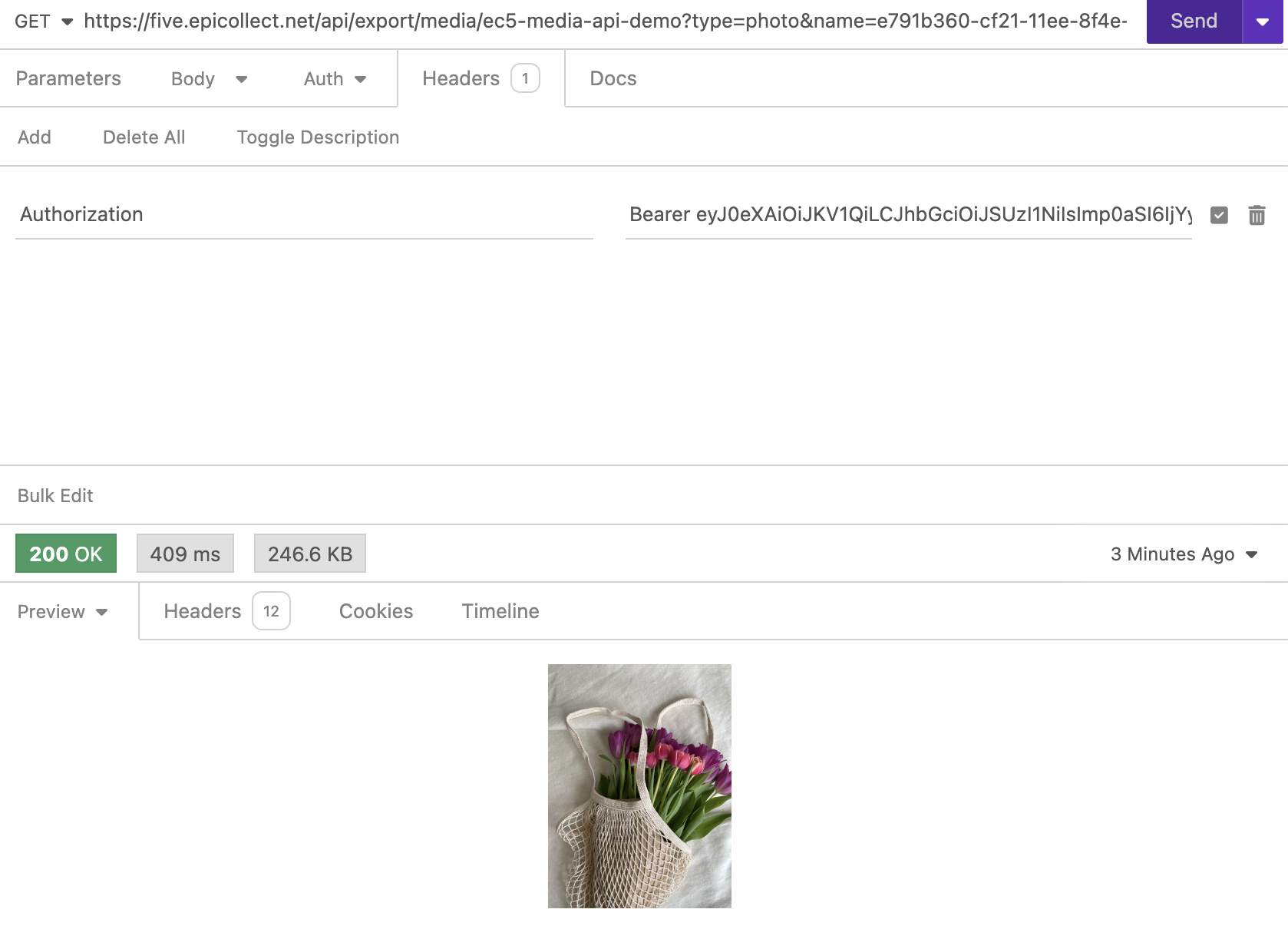
We set up a private project for testing called [EC5 Media API Demo](https://five.epicollect.net/project/ec5-media-api-demo).
The project has a single entry with a photo.\
\
The credentials to access this project entry are as follows:
client ID
4945
client Secret
djCKm1JGxDJ2zwjr10I4WNkpl7QpvsAbGwimMnXr
Using a GET request with a proper authorization header and a valid token as explained in t[he authentication section](https://github.com/epicollect5/epicollect5-docs-developers/blob/master/examples/broken-reference/README.md) the photo will be retrieved correctly.\
\
`https://five.epicollect.net/api/export/media/ec5-media-api-demo?type=photo&name=e791b360-cf21-11ee-8f4e-0d257c6d0c4d_1708345534.jpg&format=entry_original`\\
Using [Insomnia ](https://insomnia.rest/)client:
### JQuery
See the fiddle at